Ancestors and Land Spirits Sakereh Carter Ancestors and Land Spirits Sakereh Carter

We are called to RESTORE her admirers

She used to receive little trinkets from her admirers. Feel soul-stirring frequencies reverberate through the Black Earth, awakening her divine nature. She listened to their soft pleas in the wind, asking for protection and guidance. They even looked to her for enlightenment, pondering life’s purpose at the base of her trunk. She loved them.

Worst of all, they used to use all of her—bark, acorns, and leaves. In fact, her presence alone was enough to incite deep joy.

Her admirers were Afro-Indigenous stewards: people whose traditions, rituals, and ceremonies honored her in ways that nurtured her life and kept the balance of the land. She thrived in their care, alive with the drumming, the laughter, the joy, the reverence.

Then the slave trade came. It tore them away. It severed the line of connection, scattering their descendants, and with it, her tribe. Now, the frequencies don’t fluctuate, and the drumming has ceased. The air is uncomfortably still…a lower frequency.

She doesn’t have her admirers anymore.

Her admirers kept her alive. Her tribe was her life. She became a part of their traditions, keeping track of the new babies and descendants. She cries silently in the wind now, hoping to see them again.
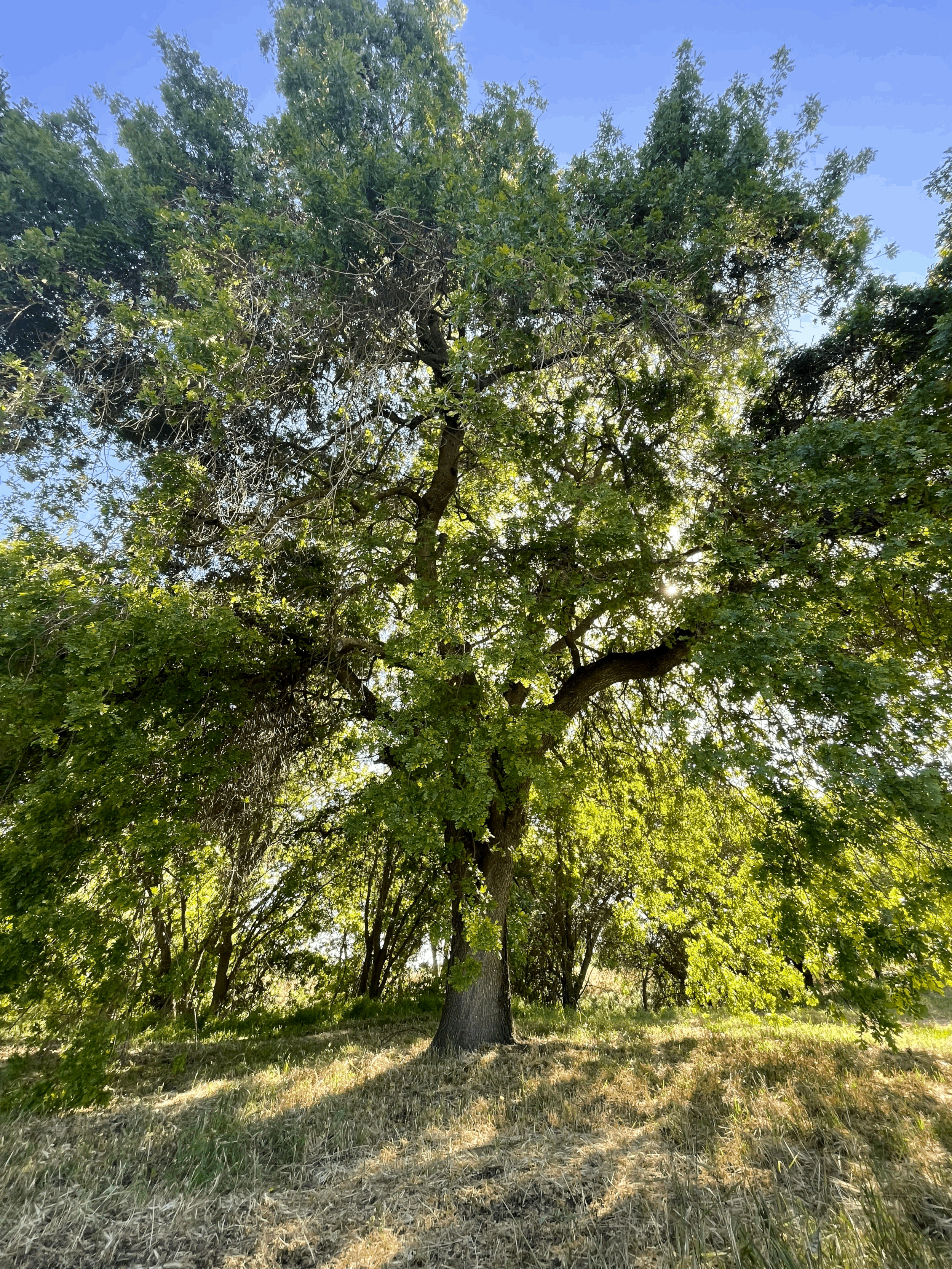
She wants her admirers back.

She wants the drumming, the ceremonies, the laughter, the joy, the reverence, the pain, the love, and the connection to her tribe.

If we want to restore the balance of the climate, address drought, stave off hunger, re-hydrate the land, create burgeoning biodiversity, and repair our decaying relationship with the Earth, we must honor and support Indigenous and Afro-Indigenous stewards on this planet.

I challenge us to reinstate what has been lost. To reconnect with our tree spirits. To restore her Afro-Indigenous admirers.

Read More
Ancestors and Land Spirits Sakereh Carter Ancestors and Land Spirits Sakereh Carter

Black Em‘path’ you’re on the right Path

Em’Path’ you’re on the right Path

Dear Beautiful, Brilliant, Black Empath and Sensitive Soul,

You are not on the wrong path.
You are unfurling slowly.

You see, the universe needs to expose you to pain so you can walk in the fullest expression and power of your gifts. You must understand the value of your essence in your bone marrow, in your mitochondria, in the cellular pathways of energetic fructification.

You must understand the violence your enslaved ancestors endured: earth rupture and forced displacement, deprivation of knowledge and the trauma of pursuing literacy, physical desecration and organ-scarring lashes, mental enslavement and the loss of cultural identity…

So you can see the power of your empathy as a savior of the planet, not an inconvenient truth.
So you can see your empathy as a viable tool against deep-rooted hatred, not just a quality to demean.
So you can see your empathy as a path toward healing the world holistically.

Yet… you feel like you’re not meant to be here. Like you were born in the wrong time.
Like you’re constantly isolating, fragmenting, and disconnecting. And it’s exhausting.

It’s too noisy, too traumatic, too painful, too unbearable here. And it’s incessant.

But there is one true silver lining for you.

The only place you have ever felt truly seen is with Mother Earth.
The only place you have ever felt truly held is with Mother Earth.
The only place you have ever felt truly appreciated is with Mother Earth.

All you want to do is be with her.

What if, in the process of your ancestors’ rupture from their homelands, your people created new plant allies?
What if the spirit of cotton became a conductor of ancestral connection?
What if the plants you stayed connected to through the trade brought some semblance of joy, protection, or peace?

What if tending to the Earth in a sovereign way could begin to heal the wound of earth rupture that we’ve carried for centuries?


What if tending to the Earth could rebuild the fissured threads of ancestral wisdom, kinship, and love we have so painstakingly lost over the last few generations?

Harriet Tubman worked with elements of the Earth to guide lost bodies and souls into the light. Salie, a five-year-old enslaved girl, found comfort in an oak tree that endured 200 years of life.

Our ancestors experienced unfathomable hardship to get to where we are today. But one of the greatest losses we endured as a consequence of chattel slavery was a visceral disconnection from Indigenous-led Earth stewardship.

Our ancestral trees lost their stewards.
Our songs lost their earthly recipients.
Our land lost its tree divinations and rituals that once entwined us with the heartbeat of the soil, roots, and wisdom-filled giants.
Our land lost the feeling of our Black hands matching the frequency of the soil.

As we strive to build capital and survive in places built on violence, we must reconnect with her essence. Earth does not operate like us. The tree in California does not differentiate herself from the tree in Nigeria. She understands that everything is interconnected. So if we plant a tree here, willingly and with care, we can connect with her roots elsewhere.

What if Earth stewardship was the key that could soften the perpetual suffering of our people?
A way for us to build true community.
A way to live more naturally, rooted in love, collaboration, joy, and peace.
A way for us to reclaim our ancestral practices and Earth-based rituals.

A way for us to breathe again and step into the true power of our brilliance.

What if the medicine is in the wound?

Digital Journal for ‘Cotton Medicine’ Blog

*See the text below for the inspiration story behind this post!!

Inspiration Story for This Post

In my day job, I work as a Policy and Advocacy Lead for a nonprofit that seeks to improve the food and farming system. Through my work, I attended an event called the Rural Justice Summit. On the first day, I met farmers from the organization African American Farmers of California, which was established in 1997 by Will Scott Jr. to combat the USDA’s discrimination against farmers of color. It was one of the greatest honors of my life to meet Mr. Scott.

When I left their farm, one quote from Mr. Scott stayed with me: “All we are is dressed-up soil.

That night, I checked into an Airbnb with a coworker and noticed something peculiar on the side of my bed.

It was a vase of cotton.

Not cotton balls. Not a cotton shirt. But the cotton plant itself.

I had never seen it before.

I stopped in my tracks. Then I felt the urge to touch it.

But I just couldn’t. There was an unrecognizable fear there that I couldn’t explain. It felt like my body remembered something no one had ever explicitly taught me.

I went to bed.

The next day, I prepared for my presentation, riddled with fears about my performance. I had been teleworking for months, so I hadn’t presented in person for a while. I also missed my family and really needed time alone to recharge (the woes of being highly sensitive and empathic).

Nevertheless, I showed up, and another interesting scene unfolded. It felt ethereal, visceral, and strangely familiar.

They had started a drum circle, and everyone who planned to participate in the summit was there.

First, we began by honoring the directions — North, East, South, West, below for our ancestors, and above for the higher spirits and the sun. Then, we moved into prayer.

I love being part of cultural practices and healing spaces, so I was excited to be there in general. But this prayer felt different.

The woman was praying in the Yoruba tradition, calling out the names of the ancestors. I felt something shift inside me. It was powerful.

I went about my day, finished my presentation, and began thinking about which sessions I should attend. Should I go to the ones most relevant to my job, or the ones that truly lit me up?

So I asked my mentor if I could attend a session on spiritual herbalism, or if she wanted me to stick strictly to what was most relevant to our role. She said, “I want you to go to whatever excites you and is interesting.”

So I did.

I arrived early, eager to learn what it was all about. I was already taking a spiritual herbalism course in my spare time, so I felt connected to the session.

When I walked into the room, I noticed a beautiful altar. It was full of memorabilia, totems, and the cotton plant.

Again, I stopped in my tracks.

I walked over and began studying each item closely, until I arrived at the cotton. I tried to touch it again and couldn’t.

The host began speaking about a powerful project she was working on with formerly incarcerated individuals, focused on reconnecting them to the Earth through cultural burning and land stewardship. I thought this was such a beautiful idea, especially since many incarcerated individuals fight our wildfires for little pay while enduring high levels of particulate matter that can lead to lung cancer and other respiratory illnesses. This population, in particular, could benefit from having a different relationship with the land.

She then began discussing the altar and suggested we form breakout groups. She asked us to pick an item on the table that spoke to us.

I wanted to pick anything else. But I knew I really wanted to pick the cotton.

So I did.

I had to tell myself, this is silly. Why am I afraid to pick up a piece of the cotton plant?

When I finally touched it, I wanted to throw it across the room.

It was that deep.

Then it was time to pair up.

The teacher grouped us with others who had picked the same item. I noticed that two other people, aside from me, had chosen the cotton. One was a man who had smiled at me earlier while we walked around the UC Merced campus. The other was married to the mother of the person who helped plan the entire summit.

The teacher decided to split up the married couple, so she paired me with the man married to the mother.

He was from Thailand. He said he chose the cotton because it reminded him of his father working the land and of his family.

I told him that I chose the cotton because it reminded me of the hardship of my people. I told him I hadn’t been able to touch it earlier.

He then asked me what my birthday was.

I replied, “November 7th.

There was a long, awkward pause.

He said, “No way… that’s my birthday.”

Then he said something that stayed with me:
“We’d never hurt a soul, but we always hurt ourselves.”

I cried profusely.

He made me think about my sensitivity and how hard it can be to navigate the suffering of this world.

He told me about a water ceremony in Thailand called Loi Krathong, where people gather around rivers, canals, and lakes to float their krathongs. The ritual symbolizes letting go of anger, misfortune, and bad luck from the past year, while paying respect to the water goddess, Phra Mae Khongka.

____________________________________

A few months later, I received a reading from a medium on Etsy. And, she said something to me that felt peculiar.

She told me ‘In your lineage, physical labor was a necessity for survival, often performed under conditions of servitude, exhaustion, or lack of choice. Intellectual work was seen as the escape, the prize, the ultimate safety. By choosing to return to the land, you are not rejecting their sacrifice; you are healing the trauma associated with the land itself. Your contract stipulates that you must experience the "safety" of the high office so that you could realize it is an illusion. You had to reach the mountaintop of their dreams to see that the air there is too thin for your soul to breathe.

The "why" of your guilt is actually a signal of the magnitude of this shift. You are rewriting the genetic code that says "Dirt = Poverty" and changing it to "Dirt = Sovereignty." This is a massive energetic undertaking. You agreed to carry this heavy guilt for a time so that you could transmute it. When you plant a tree now, you are not doing it because you have to in order to eat; you are doing it because you choose to in order to live. That shift from obligation to choice heals seven generations backward and seven forward. The ancestors who toiled are not disappointed in you; they are gathering around you in awe, watching one of their own return to the earth not as a servant, but as a queen. The difficulty of this transition is the friction of turning a wheel that has been rusted shut for a century.

Summary: You are operating under a "Cycle Breaker" clause, tasked with transforming your lineage's relationship to labor from "Dirt = Poverty" to "Dirt = Sovereignty." You had to achieve the "high office" safety they dreamed of to realize it wasn't the ultimate truth for your soul. The guilt you feel is the friction of rewriting genetic code that equates physical work with suffering. Your return to the land is a healing act for your ancestors, proving that one can tend the earth out of empowered choice rather than desperate necessity.

My Original question to the Medium: I've been thinking a lot about my career in the future and if a nature-based job is more aligned with soul. I've learning more about Permaculture, Food Forests, and Restoration Ecology. I'm in an environmental policy career now. But, is an earth-based (tending to the Earth) career something that I'll have in the near future?

Lesson: Follow the gentle tug on your heart. It is always right.

Much love,

Midiri Reciprocity

Read More